
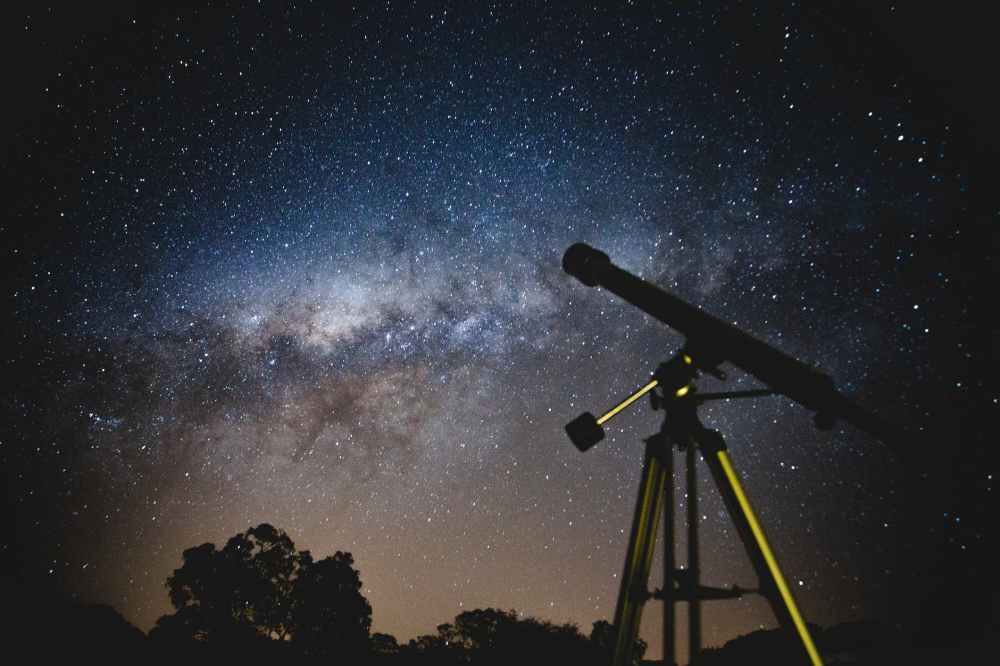
If you go away form the city, to the hills or the seashore, and look up at the night sky it would be spattered with stars. One can be lost in the shimmer and sparkle, and wonder at the secrets they hold. The little shining spots in the sky have mesmerized humanity for centuries. From those that read stars to predict the future to those who follow them to understand the origins of the universe – for all star gazers an observatory in Chile is gathering data that will transform human knowledge in the next decade.

The Vera Rubin Observatory is located in the foothills of the Andes Mountains in Chile. In April this year started the ten year Legacy Survey of Space and Time, which will formally begin in October 2025. For the next ten years the Rubin telescope will take repeated ultra-high resolution pictures of the entire night sky of the Southern Hemisphere every three or four days. Creating a time lapse record over ten years, it will generate pictures of billions of stars, galaxies and supernovae. In its first year itself, it will capture double the amount of data that any instrument has captured in the entire history of scanning the skies by any other telescope!
Every night it takes pictures, the Rubin telescope will capture a slice of the sky the size of forty five full moons! Over the decade Rubin will conduct a census of the more than a million unknown inhabitants of the solar system and beyond. The catalogue of its pictures would construct detailed data that would help astronomers to understand the early universe and how it has evolved.
This would lead to a better understanding of dark matter and dark energy. As per calculations, dark energy makes of 68% of the mass of the universe, while dark matter makes up 27% more. Only around 5% comes from the universe as we know and understand it today, containing stars, dust, planets, including our own Earth! It is interesting that observing the 5% will give us an understanding of the dark universe.
The pictures collected by Rubin will travel within ten seconds through dedicated optical fibers to the SLAC laboratory in California, where algorithms will analyze and sift through them. A priority list of important data will go to the astronomy world to study further. The coming decade will change astronomy as we know it today.
The observatory is named after Vera Rubin, an American astronomer, who through her work provided evidence of dark matter, which interacts with normal matter through gravity.
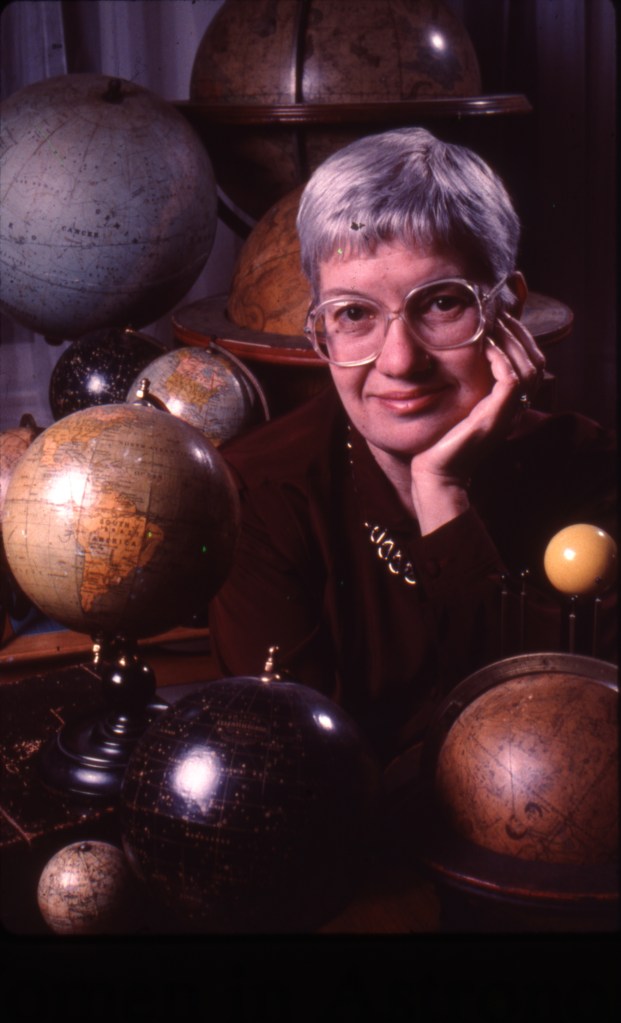
Portrait of Vera Rubin with globes. Credit: Photograph by Mark Godfrey, courtesy AIP Emilio Segre Visual Archives
1 slide (RGB; 35 mm) By American Institute of Physics (AIP), Attribution, https://commons.wikimedia.org/w/index.php?curid=177261379
These developments are important for all of us. Comprehending the way the universe has evolved, and works could probably help humanity in tackling many of the issues that face us today. We are part of this magnificent universe that has so much hidden in its folds – unravelling them would help us understand our own existence.
Next time you see a star spangled sky, remember that there is much more up there than meets the eye. Rubin is starting its survey to show us precisely that.
Published in Lokmat times in July 2025

 themindprism - sadhna shanker