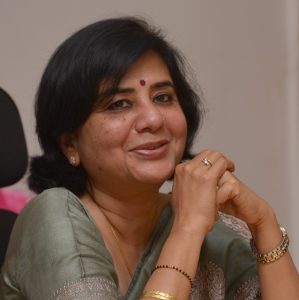
‘CONTINUUM’ – my latest sci-fi novel was launched on March 8,2025 in New Delhi by Mr Kiren Rejiju, Hon’ble minister for Parliamentary Affairs and Minority Affairs, Government of India. Padamshri Ms Mamang Dai, author and poet and Mr Vikas Swarup, celebrated author and former diplomat spoke on the occasion.
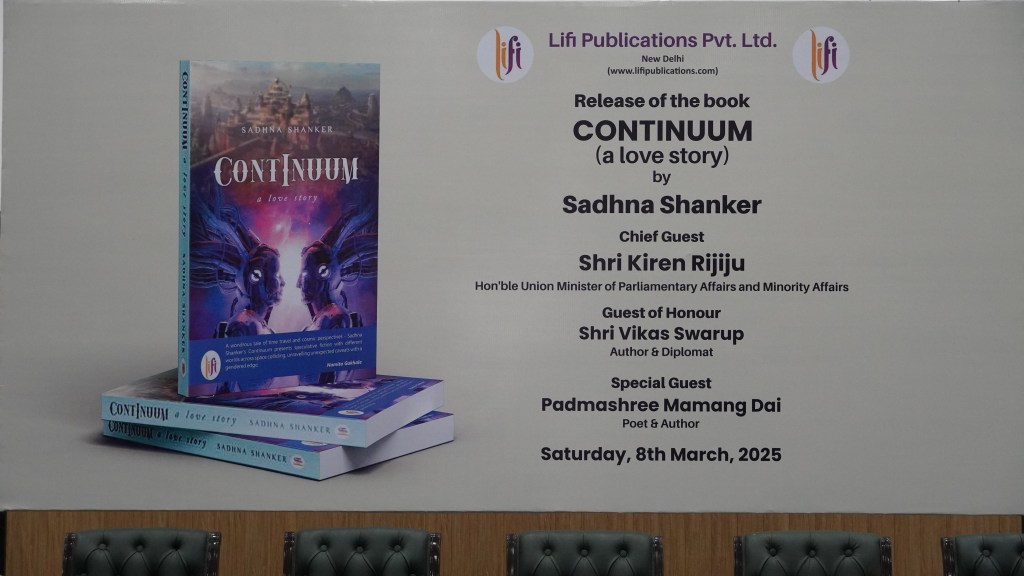

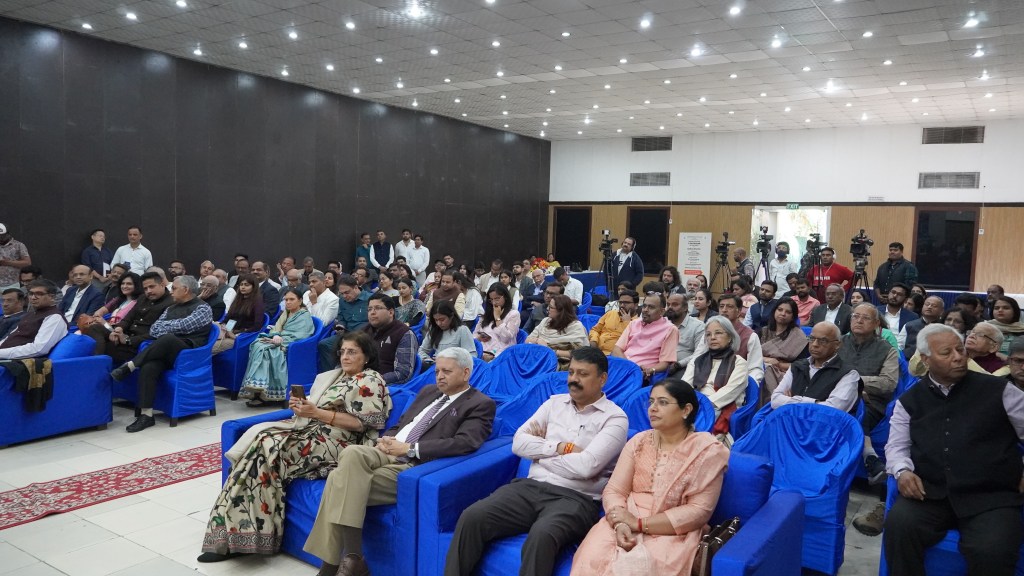
Below is the speech of Mr Vikas Swarup on the occasion , whose debut novel Q&A was made into the Oscar nominated ‘Slumdog Millionaire’-
“It is a pleasure to be here today to celebrate the launch of Continuum, a novel that takes us on an intricate journey through time, memory, and identity. Dr Sadhna Shanker has woven a tale that is as thought-provoking as it is engaging, blending mythology with science fiction, history with the distant future, and the deeply personal with the cosmic.
At its heart, Continuum is an exploration of a world where time does not flow in a straight line. We are introduced to Samar—also known as Trion—a traveller from the planet Elone, which exists thousands of years into the future. But Elone is not just any world; it is a planet where women have long since disappeared, leaving only men behind. The story of how this happened was once told as a triumphant one: men vanquishing women and claiming the planet for themselves. It was seen as a victory. But was it truly a triumph? Or was it the beginning of an irreversible loss?
Through Samar’s journey, the novel challenges us to reflect on these themes. What happens to a world without women? Can men truly thrive alone? And in a broader sense, it makes us consider gendered histories, stretching all the way back to Draupadi’s humiliation in the Mahabharata. Have things really changed over time, or do these cycles repeat in different forms?
That is why it is no coincidence that we are meeting on International Women’s Day.
Samar finds himself transported—not to his intended destination, but to Mrugjala, a town that exists outside of ordinary time. There he meets Alia, a woman who is struggling with a strange and disorienting experience: following an accident, she begins to recall memories that do not belong to her. These are not just fragments of forgotten moments but the memories of Malini, a maid who lived during the time of the Mahabharata. Alia’s journey becomes a compelling meditation on memory and identity. If we can remember the past so vividly, does it mean that part of us still exists in another time?
Her mother’s words encapsulate this beautifully: We all live in different realities and time zones in our minds all the while. What is memory, but a step back in time? And our daydreams, aren’t they a dance in the future? This single thought is at the core of Continuum, asking us to consider whether time is truly linear—or if past, present, and future are in a constant, fluid conversation with one another.
Adding another layer to the novel is the presence of Tarun, a character described as an ‘American Bred Confused Returned Desi’—an ABCRD—who brings a different perspective to the mix. Through him, Shanker subtly weaves in themes of displacement and belonging, not just across time and space but also within cultures and identities. His presence alongside Samar and Alia provides an interesting contrast, reminding us that we are all navigating our own versions of time travel—through our histories, our inherited identities, and the futures we imagine for ourselves.
Reading this book, I was reminded of a Hollywood film K-PAX. The movie, starring Kevin Spacey, revolves around a man named Prot who claims to be from a distant planet called K-PAX. He arrives on Earth and is quickly institutionalized because, of course, no one believes him. But as the film progresses, small details begin to emerge—his knowledge of astronomy, his uncanny ability to see light spectrums invisible to humans, his detached yet profoundly observant nature. The audience is left wondering: Is Prot delusional, or is he really an alien?
Similarly, in Continuum, Samar—our traveller from Elone—finds himself in a place where his identity is constantly questioned. His presence disrupts the ordinary flow of life, just as Alia’s resurfacing memories blur the lines between past and present. While K-PAX used science fiction to explore the nature of belief and human perception, Continuum takes a different but equally compelling route. It uses the lens of time-travel and mythology to examine identity, gender, and the consequences of societal shifts. It raises the same fundamental question: How do we define what is real?
What makes Continuum so compelling is the way it blends diverse elements—mythology, science fiction, romance, and philosophy—into a single narrative. It does not simply tell a story; it raises questions, encourages reflection, and presents a vision of time and reality that lingers in the mind long after the last page has been turned. It is a novel that does not rush towards easy conclusions but instead allows its ideas to unfold, inviting the reader to contemplate the world it presents.
As we celebrate this book launch, I encourage all of you to step into the world of Continuum, to let its questions challenge you, and to engage with the possibilities it presents. Sadhna Shanker has given us a work that is ambitious in scope and rich in imagination, reminding us that fiction is not just about telling stories—it is about opening doors to new ways of thinking.
Congratulations to Dr Sadhna Shanker on this remarkable achievement. May Continuum find the wide and engaged readership it deserves.”


 themindprism - sadhna shanker